
And what are products without a medical purpose?
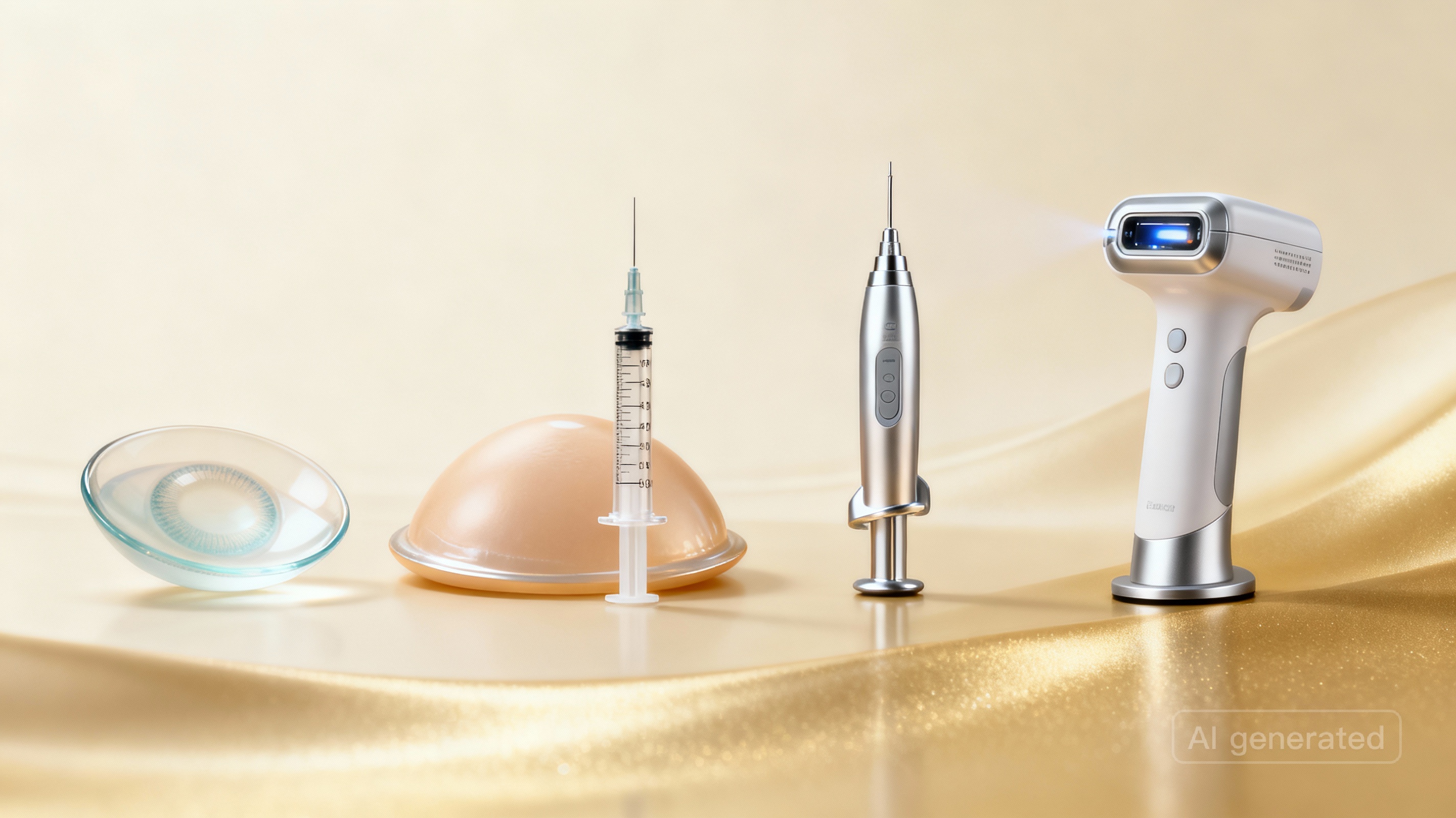
Products without medical purpose (Annex XVI MDR) are products which, although they do not have a medical purpose intended by manufacturers (e.g. aesthetic or cosmetic goals), are nevertheless subject to the same regulatory monitoring as “classic” medical devices — such as colored contact lenses, liposuction devices or dermal fillers.
Where is this regulated?
1. MDR Annex XVI — lists the six specific product groups that fall under MDR requirements despite their lack of medical purpose.
2nd Implementing Regulation (EU) 2022/2346 —sets common specifications for all Annex XVI product groups, including product-specific requirements for risk management, safety information, labelling and operating instructions (applicable as of June 22, 2023).
3rd Implementing Regulation (EU) 2022/2347 —regulates the reclassification (reclassification) of certain active Annex XVI products, as MDR classification rules 9 and 10 (active therapeutic/diagnostic) relate to medical purposes (in force as of December 22, 2022).
4th MDCG 2023-5 and MDCG 2023-6 — Guiding Medical Device Coordination Group for the qualification and classification of Annex XVI products.
5th MPDG (Medical Devices Implementation Act)— German implementation of MDR requirements, including Annex XVI regulations.
6th National government guidelines — e.g. vombFarm in Germany for practical use with Annex XVI products.
Which products - although they are not products for medical use - are affected by meeting these high MDR safety standards?
Annex XVI lists specific products that: none should have medicinal healing effects, but must still be regulated in the same way as medical devices — because they pose similar risks.
The six product groups:
- Contact lenses without vision correction — colored or tinted contact lenses purely to change the appearance, not to improve vision.
- Fixed implants for body alteration — e.g. silicone breast implants or other permanently inserted objects that change the body shape (piercings and tattoos are not included).
- body fillers (dermal fillers) — Substances that are injected into the face or other skin/mucous membrane areas to plump up (e.g. hyaluronic acid fillers, collagen implants).
- liposuction devices — Devices for the mechanical reduction, removal or decomposition of adipose tissue (liposuction, fat melting, fat formation).
- high power lighting devices — Devices that emit thermal radiation, visible light or UV radiation (laser, intensive lighting devices) for hair removal, tattoo removal, skin tightening or other skin treatments.
- brain irritation devices— Devices that conduct electromagnetic fields through the top of the skull to change brain activity.
What makes Annex XVI products special from a regulatory perspective?
As with real medical devices, manufacturers must show that these products are safe. But: You must no medical benefit prove that there should be none. Instead, they must meet the following requirements:
- risk management: Systematic recording and reduction of risks
- General requirements (common specifications): Product-specific requirements in accordance with Implementing Regulation 2022/2346, which have been in force since June 2023
- grading: Division into risk groups (usually class IIa or IIb) in accordance with Implementing Regulation 2022/2347
- Compliance rating: Depending on the class, by notified bodies or self-declaration
- Post-market monitoring: Systematic monitoring after market launch
- Labeling and user manual: Must be clearly marked as “without medical determination”
What does this mean for manufacturers?
For manufacturers, this means that they must implement the entire MDR compliance architecture for Annex XVI products — including quality management system, risk analysis, clinical evaluation, conformity assessment by notified bodies (depending on risk class) and post-market surveillance — although these products are not formally marketed as a “medical device,” leading to significant regulatory and economic challenges, particularly when differentiating from clinical evidence and safety requirements.
Do these products require a clinical trial to confirm a healing statement?
No, Annex XVI products do not need a clinical trial to confirm a healing statement — because, by definition, they cannot make a healing statement. However, they require clinical evaluation.
According to Article 61 (9) MDR, for products without a medical purpose (Annex XVI), the requirement to have a clinical benefit to prove, by the requirement to only the Safety and performance to prove the product. These products must not claim any medical or therapeutic effectiveness — any healing statement would be prohibited by regulation and would automatically recalibrate the product as a medical device with a medical purpose, meaning that the Annex XVI regulation would no longer apply. It is interesting that clinical testing is nevertheless generally required, unless there is an “analog” medical device that is equivalent to the corresponding product without a medical purpose.
Do you need an assessment or initial advice on the classification of your medical device or are you wondering whether you need a clinical trial or clinical trial? Contact us for an initial consultation!
Show the medical benefits of your product
With our many years of experience and expertise, we offer effective solutions to demonstrate the medical benefits of your product.
From the conception to the execution of preclinical and clinical investigations, we support you with customized services.
Find out how MEDIACC can help you achieve reimbursability for your products.