
ISO 14155:2026: No transition period for sponsors and contract research organisations (CROs) – what you need to know
Type image caption here (optional)

The new ISO 14155:2026 standard is here – what this means for you
The new ISO 14155:2026 is not just "another update" to good clinical practice for clinical investigations of medical devices – it is a new foundation with no transition period, which has an immediate impact on how sponsors and contract research organisations (CROs) design, conduct and document their clinical studies.
ISO 14155:2026 in a nutshell:
- sets out requirements for the planning, conduct, documentation and reporting of clinical investigations of medical devices,
- describes the principles of Good Clinical Practice (GCP) and supports the safe, ethical and scientifically sound conduct of clinical studies involving medical devices,
- serves as a central basis for collecting robust clinical data and supports manufacturers, sponsors and clinical sites in the clinical evaluation of medical devices (with a focus on safety and performance),
- defines requirements for study design, risk management, monitoring, data management and quality management,
- is revised every 5 years.
Overview of ISO 14155 topics:
- Clinical investigation and clinical study of medical devices
- Good Clinical Practice (GCP) and ethical requirements
- Protection, safety and rights of study participants
- Roles and responsibilities of the sponsor, investigator and monitor
- Risk management and clinical evaluation of medical devices
- Data collection, documentation and quality management
- Monitoring, auditing and reporting of clinical investigations
Specific changes in ISO 14155:2026 compared to the previous version (selected relevant points):
Additional note on the definition of clinical performance (3.12)
In note 2 to the term "clinical performance", ISO 14155:2026 clarifies that a clinical benefit for study participants is not a necessary feature of a clinical investigation. The standard cites investigations involving healthy volunteers and investigations whose sole purpose is data collection as examples.
Inadmissibility of deviations from selection criteria, clinical investigation plan amendment required (5.6.4b)
ISO 14155:2026 specifies the information that must be submitted to the ethics committee regarding deviations from the clinical investigation plan (CIP). The stricter requirement—whether that of the CIP or the ethics committee—always takes precedence.
Applications for deviations submitted in advance, as well as reports on deviations that have already occurred, must be provided. However, this only applies if the deviation affects the rights, safety, or well-being of the clinical investigation subjects or could jeopardise the scientific integrity of the investigation; minor deviations must be documented but are not subject to reporting requirements.
Deviation applications are not permitted for inclusion and exclusion criteria. A subject who does not meet the criteria cannot be enrolled via individual case approval; any change to the participant population requires a formal amendment to the clinical investigation plan, subject to the standard approval process.
Clarification that informed consent may need to be obtained from the clinical investigation subject's legally authorised representative (5.8.1)
Informed consent must be obtained in writing before any investigation-specific procedure is performed on subjects. It must be provided by the subjects themselves or, where applicable, by their legally authorised representatives. In addition to the consent itself, the process of informing the subject and obtaining consent must also be documented—the signed declaration alone is insufficient.
The standard allows for one exception: it refers to special circumstances under section 5.8.3.4, which governs emergency treatment. Only in these cases may an investigation-specific procedure be performed before consent is obtained.
Opportunity for clinical investigation subjects to discuss study participation with others (5.8.2)
Clarification that clinical investigation subjects must be given sufficient time to consider their decision. During this period, they should be able to read and understand the patient or subject information and the informed consent form, clarify any outstanding questions, and—if they wish—discuss participation with third parties, such as family members. The standard does not set a fixed time limit; the key requirement is that subjects are able to make the decision regarding their participation in the clinical investigation freely and without time pressure.
Clarification of risk management with a clear distinction between risks associated with the use of the device and risks associated with procedures required by the CIP that are not part of routine clinical practice (6.2.1)
Refinement of clinical investigation risk management through a clear separation of two risk categories: firstly, risks associated with the use of the investigational device, and secondly, risks arising from procedures required by the CIP, insofar as these go beyond routine clinical practice. Both categories must be recorded and assessed separately.
Regarding the first category, Note 1 clarifies that device use encompasses not only the risks of the device or technology itself, but also those of the application procedure specified in the instructions for use (cf. definition in 3.1).
Regarding the second category, Note 2 explains that this includes, in particular, follow-up measures performed in addition to routine care and independently of device use—such as additional imaging or blood sampling. The standard also notes that the benchmark of "routine clinical practice" may vary by region; what is standard at one investigation site may constitute an additional investigation-related procedure elsewhere.
Inclusion of the required assessment of residual risks, including a quantified estimate (6.2.2)
A new requirement is an explicit assessment of residual risks, which includes a quantified estimate. This is based on risk management according to ISO 14971; residual risks must be considered in relation to the planned sample size of the clinical investigation or the target population (details in Annex H). The standard thus links risk assessment directly to statistical planning: a residual risk is not to be assessed in the abstract, but in relation to the number of exposed subjects.
The assessment must be based on, or refer to, an objective review of available medical and scientific data—expressly including unpublished data. As a requirement, the specific indication and population under investigation must be included in the consideration.
A summary of the benefit-risk assessment must be disclosed in the relevant investigation documents. The residual risk itself must, where applicable, be presented in the Investigator's Brochure (IB, cf. B.5) and in the instructions for use—differentiated by type of hazard, frequency of occurrence, severity, and potential health consequences.
Data Monitoring Committee for confirming the conditions for suspending or terminating the clinical investigation (6.11)
Obligation for the sponsor to assess, before the start of the clinical investigation, whether a Data Monitoring Committee (DMC) should be established. This decision must not be made as a blanket policy but must be based on the risk assessment and justified accordingly.
If a DMC is established, it has an additional task: it must confirm the conditions specified in the clinical investigation plan under which the investigation will be interrupted or terminated prematurely—though only insofar as these conditions are relevant to the safety management of the investigation. Termination criteria based purely on operational or economic considerations are not included.
Clinical Events Committee (3.8, 6.12 and Section A.14)
Introduction of the term Clinical Events Committee (CEC). The standard recognises several equivalent terms for this: central events committee, clinical adjudication committee (CAC) and endpoint adjudication committee (EAC). Regardless of the name used, the same body is intended.
It is defined as an independent panel of clinical experts, the appointment of which is at the sponsor's discretion – there is no obligation to establish one. Its tasks and working methods are regulated by the standard in Section 6.12; requirements for its description in the clinical investigation plan can be found in Annex A.14.
Clarification of situations where adverse event reporting requirements are restricted (7.4.2)
The recording or reporting of adverse events in certain clinical investigations can be restricted. However, such a reduction is subject to three conditions: it must be explicitly specified in the CIP, have a justifiable rationale [cf. A.14 d)], and be approved in advance by the ethics committee – and, where applicable, by the competent authority. Subsequent or tacit restriction is therefore excluded. The standard cites specific clinical investigations post-market (e.g. PMCF investigations), where the safety profile of the product is already known, as particular use cases.
Inclusion of risk management in connection with clinical procedures required under the CIP (7.4.5)
Investigation-related clinical procedures – i.e. those prescribed by the clinical investigation plan (CIP) beyond routine care – must be subject to a risk-based approach. These procedures are therefore not automatically permissible; they must be assessed and justified with regard to their additional risk to participants (supplementary notes in I.6, 6.2.1 Note 2 and 6.2.3).
If potentially unacceptable risks emerge during the course of the investigation, the sponsor should take action: either by pausing the investigation in conjunction with corrective measures or by terminating the clinical investigation prematurely (procedure according to 8.2). The standard formulates this as a recommendation, thereby leaving the sponsor with a degree of discretion.
In the event of a pause, the standard clarifies that the necessary corrective measures may entail an amendment to the CIP. If this is the case, the investigation may only be resumed after the amendment application has been approved (see 8.2.4).
Clarification of requirements for non-inferiority margins and missing data (Section A.7)
ISO 14155:2026 specifies the requirements for sample size planning for non-inferiority designs in Annex A.7. The calculation of the sample size must be justified and must explicitly take the chosen non-inferiority margin into account. The standard sets a substantive limit for this margin: it must be smaller than the effect size that can be demonstrated for the comparator. Furthermore, the validity of the margin must be justified – if necessary, by referring to the proven effect of the comparator.
Clarification regarding the local representative for better harmonisation with national regulatory requirements (9.2.1)
The role of the local representative is clarified to achieve better alignment with national legal systems. If the sponsor is not established in the country or countries where the clinical investigation is being conducted, they must appoint a local representative before the investigation begins. The obligation therefore arises for each country of conduct, not just once.
The standard itself does not definitively regulate the selection criteria or the scope of the representative's duties, but refers to national or regional regulations, which may take precedence in this regard.
Additional note for Europe: In the EU context, this corresponds to the legal representative under Art. 62(2) of the MDR (EU Regulation 2017/745), which a sponsor not established in the Union must appoint.
Update to the categorisation of adverse events with clarification of terminology (Annex F)
Adverse events (AE, 3.2) are classified in Annex F, Table F.1, along two axes: severity (non-serious / serious) and causal relationship. Regarding the causal relationship, the standard distinguishes between three columns: no relationship to the product, relationship to product use, and – newly highlighted – relationship to an investigation-related procedure prescribed by the CIP beyond routine care, without the product being involved.
This results in the following categories: events without a product link remain AEs or SAEs. Product-related events are adverse device effects (ADE) or serious adverse device effects (SADE, 3.45). The latter are further subdivided according to predictability: into anticipated SADEs (ASADE, 3.52 Note 1) and unanticipated SADEs (USADE, 3.52). Events resulting from additional investigation-related procedures are classified as AEs or SAEs without a product link, but with the explicit note that they originated from a CIP procedure outside of clinical routine.
The footnotes refer to 6.2.2, 7.4.4 and Annex H for the handling of product-related events, and to 6.2.3 and 7.4.5 for procedure-related ones. Furthermore, the standard clarifies that national regulations do not necessarily require the separate categorisation of procedure-related AEs.
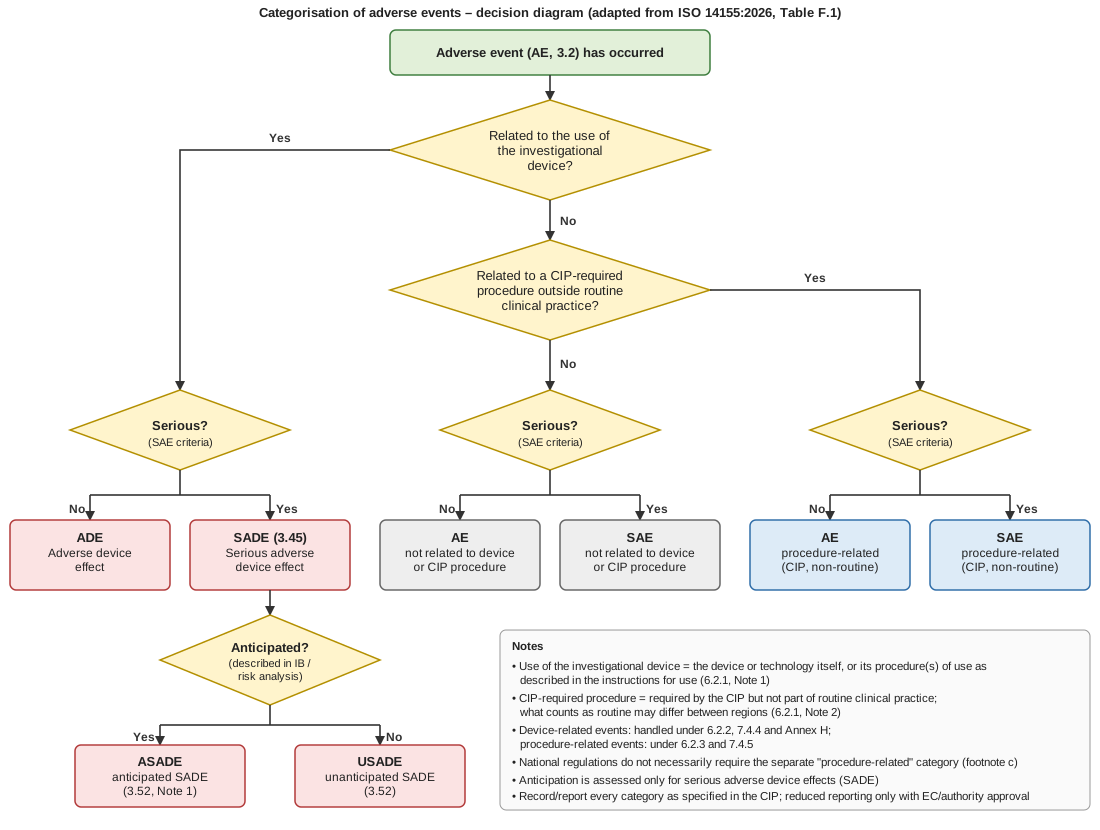
Practical consequence: In addition to "product yes/no", the causality assessment must in future also document "investigation-related procedure yes/no"; CRFs and safety reports must be designed accordingly.
Inclusion of estimands and their attributes (6.4, Section A.5, Section A.6, Section A.7, new Annex K)
With the 2026 version, ISO 14155 incorporates the estimand concept into the planning of clinical investigations (6.4, A.5–A.7, and the new Annex K). The starting point remains the investigation objective: it must directly determine the pre-specification and operationalisation of the primary endpoint(s) – the objective and the endpoint must not stand side-by-side in isolation.
Where appropriate, objectives should be translated into one or more estimands. The standard defines this as a precise description of the treatment effect that answers the exact question posed by the investigation objective. An estimand is defined by five attributes: the treatment considered, the target population, the variable (endpoint), the population-level summary (e.g. mean difference or risk ratio), and the handling of intercurrent events.
The latter point in particular requires interdisciplinary scientific input according to the standard: which events occurring after the start of treatment – such as discontinuation of therapy, additional treatment, or product failure – influence the interpretation of the endpoint, and how they are strategically handled in the analysis, must be determined jointly from both a clinical and statistical perspective (details in Annex K). The content of this concept corresponds to ICH E9(R1); however, the ISO refers to its own Annex K.
Inclusion of precautions (Section B.5), information on training for the use of investigational products (Section B.2), and in silico investigations (Section B.3);
Extension of the requirements for the content of the Investigator’s Brochure (Annex B) in three areas:
In the section on the risk management of the investigational product (B.5), precautions must now be included in addition to the warnings previously required. The intention is for the IB not only to state what hazards exist, but also what measures are intended to avoid or mitigate them during use – following the structure of instructions for use.
It is also new (B.2) that the IB must contain information on training regarding the use of the investigational product. This is intended to allow the investigation site to track what training investigators and investigation staff receive before using the product.
Finally, regarding preclinical data (B.3), the standard explicitly includes in silico investigations – i.e. computer-based simulations and modelling – as a supplementary source of evidence alongside laboratory and animal studies.
ISO 14155:2026 and the MDR – two perspectives, one expectation
The MDR (EU) 2017/745 stipulates in Art. 62 et seq. and Annex XV what a clinical investigation must achieve: protection of investigation participants, clear roles for the sponsor and investigators, and reporting and documentation obligations. ISO 14155 describes how these requirements are implemented in good clinical practice. Two perspectives – regulatory and methodological – but the same expectation: robust data with consistent participant protection.
The 2026 version brings both worlds closer together. The separation of product and procedural risks, the quantified residual risk assessment according to ISO 14971, and the expanded categorisation of adverse events clarify what Art. 62(4) and Art. 80 of the MDR require. Clarifications regarding informed consent, reflection periods, and local legal representatives reflect Art. 63 and Art. 62(2). With estimands, non-inferiority margins, and in silico data, the standard translates the MDR’s expectation for methodologically robust evidence into concrete planning requirements.
Anyone planning and conducting investigations according to ISO 14155:2026 does not just meet the procedural requirements of the MDR incidentally, but systematically – as the foundation upon which Notified Bodies and authorities evaluate clinical evidence for CE marking and PMCF.
As an independent research institute and CRO for medical devices, we do not see the standard as a hurdle, but as a common language between the sponsor, investigation site, ethics committee, and authority. It makes expectations predictable – and clinical investigations plannable.
Are you interested in whether and how MEDIACC, as a CRO, can support you with clinical investigations in the medical device approval process? Contact us for an initial consultation!
--
(As of September 2026)
Sources: ISO 14155:2026, EU MDR 2017/745
Show the medical benefits of your product
With our many years of experience and expertise, we offer effective solutions to demonstrate the medical benefits of your product.
From the conception to the execution of preclinical and clinical investigations, we support you with customized services.
Find out how MEDIACC can help you achieve reimbursability for your products.